
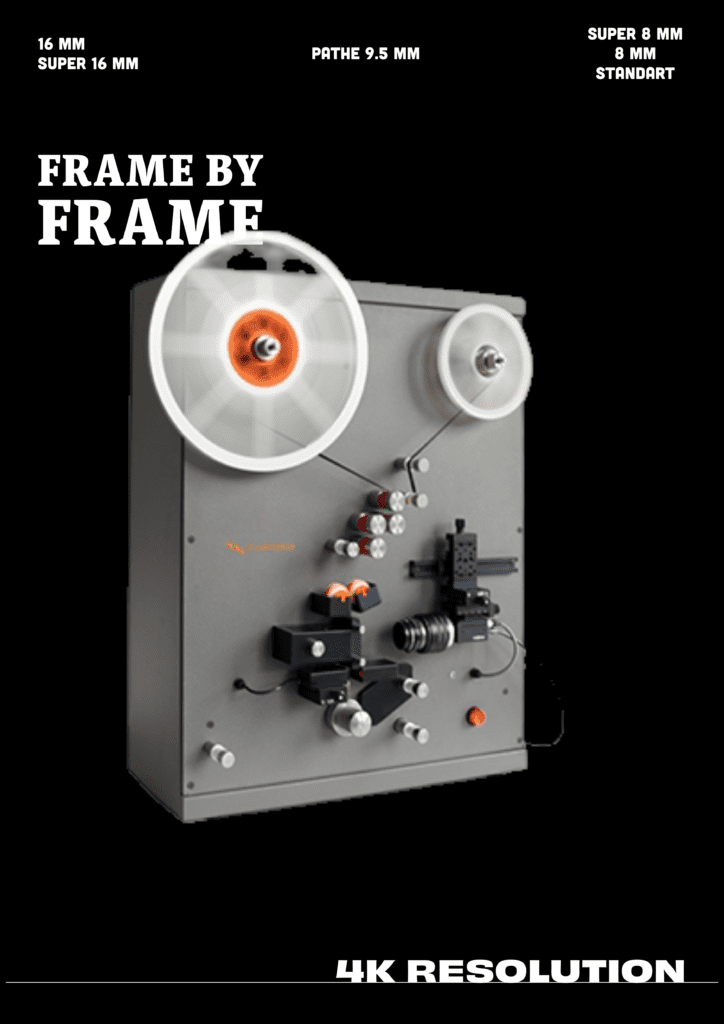
The short answer: if the reel you found has a single sprocket hole running down the middle of the film, between one frame and the next, rather than a row of holes along the edge, it is 9.5mm Pathé-Baby. It is an old European amateur format that predates the 8mm era, and it is very rare in Israel. No ordinary transfer shop recognises it, and most consumer scanners cannot touch it. We do scan it — frame by frame, without ever running it through a projector.
This format almost always reaches us the same way: somebody clears an estate, finds small metal tins holding narrow film, takes them to a place that converts tapes — and is told "that is not 8mm, it cannot be done". Sometimes that happens two or three times before they find us. So it is worth starting with identification, because once you know what it is, the question closes.
How do you identify 9.5mm at a glance?
The sign is unambiguous and impossible to mistake: the perforation sits in the centre of the film. In every other home projection format you are likely to meet — regular 8mm, Super 8, 16mm — the sprocket holes run along one edge or both, with the picture sitting between or beside them. Pathé-Baby inverts that: a single hole sits on the centre line between frames, and the image occupies almost the full width of the film.
This is not merely a technical curiosity. It is exactly this choice that gives 9.5mm a frame that is generously wide relative to the film stock — more image area than you would expect from film this narrow. The format was introduced by the French Pathé company in the 1920s as a home cinema format, and it remained common in Europe for decades, chiefly in France and Britain, while 8mm dominated the American market.
How does it differ from the formats you know?
| Format | Perforation position | How it looks in hand | Where it was common |
|---|---|---|---|
| 9.5mm Pathé-Baby | A single hole in the centre, between frames | Narrow film with a line of holes down the middle; usually in small metal tins | Europe, chiefly France and Britain |
| Regular 8mm | A row of holes along one edge | The narrowest of the three; relatively large holes | USA and Europe, 1930s to 1960s |
| Super 8 | A row along one edge, with smaller holes | Usually in a plastic cartridge rather than on an open reel | From the late 1960s onwards |
| 16mm | One or two rows along the edges | Clearly wider than all the others | Semi-professional and institutional |
If you are not sure what you are looking at, we also have a formats and media page, and a guide to identifying tapes by size if the box holds cassettes too.
Why should it never be projected?
Three cumulative reasons, each sufficient on its own:
- The central perforation is the weak point. The entire pulling force of the transport mechanism is concentrated on a single hole at the heart of the film rather than distributed across a row of edge holes. Film that has dried and shrunk over the years tears there first — and a tear at the centre of the frame damages the picture itself, not just the margins.
- The projectors are ancient and unmaintained. A Pathé-Baby projector still sitting in somebody's home is almost certainly a decades-old machine that has never been serviced. The rubber has hardened, the path is dirty, and the pressure is uneven.
- Shrunken film should not go through a projector at all. That is true of every old film format, and it is covered in our guide on projecting old film. With 9.5mm the risk is simply more concentrated.
If your film is already torn or broken, that is not the end of the story — see torn or broken 8mm film, whose principles apply here too. And if a sharp vinegary smell rises from the tin, read our vinegar syndrome guide before doing anything.
How do we scan 9.5mm?
With the same approach we take to all film: frame by frame. The film is never projected and never runs at speed past a camera; each frame is captured individually. That is what makes it possible to handle film that has shrunk, whose perforations have weakened, or that is uneven along its length — because nothing requires it to flow at a constant rate through a mechanism.
Before scanning, each reel is inspected by hand: the state of the perforations, flexibility, old splices that have come apart, and signs of decay. Repairs are made beforehand, not during. The full background on the method and the equipment is on our full transparency page — and you are welcome to come and watch a reel being scanned in front of you.
What do you get at the end?
A digital file per reel, in the format you ask for. We provide ProRes, MXF or MP4 — the first two for editing and archiving, the last for viewing and sharing. 9.5mm films are almost always silent, so the result is silent video, exactly as it was shot.
And once there is a file — 3-2-1: three copies, two kinds of media, one copy outside the house. The original reel is a single copy nobody can reproduce; the file is the first one that can be.
Got a reel with a hole down the middle? Do not go looking for a projector — send us a photograph.
We send couriers to your door anywhere in Israel, in both directions. Small jobs are usually ready within about seven business days and larger ones within about 21 business days, and the first minute is on us — you see how your film comes out before you decide. You can also hand items over in person: the studio at HaMa'ayan 9 in Rishon LeZion, Lissin 5 in Tel Aviv, or Mitzpe Hararit in the Galilee. Call 03-5610368 or leave your details on our contact page. What each service includes is set out on our price list page.
Frequently asked questions
How can I be certain it is 9.5mm and not 8mm?
By where the holes are, and the sign is unambiguous. Hold the film up to the light: if there is a row of holes along the edge, it is 8mm or Super 8. If a single hole runs exactly down the centre of the film, between the frames, it is 9.5mm Pathé-Baby. No other common home format uses a central perforation, so there is no room for doubt here.
Several places told me this cannot be converted. Is that true?
It is true of most places, and untrue in general. 9.5mm needs dedicated handling because of the central perforation, and labs that work only with 8mm and Super 8 genuinely cannot touch it. We do scan 9.5mm, frame by frame, without running the film through a projector.
My film is crumbling at the edges and old splices have come apart. Is it still worth it?
Usually yes. Old splices coming apart is entirely expected in film that is decades old, and they are repaired before scanning rather than during. Crumbling edges generally affect the margins rather than the heart of the frames. One thing though — do not try to repair it yourself with sticky tape; modern adhesive bonds the layers together and makes the later work far harder.
Is there sound on 9.5mm film?
Almost never. The format was used chiefly for silent home filming, and the overwhelming majority of reels that reach us have no soundtrack. If there is a magnetic or optical stripe on the film after all, we will spot it during the manual inspection before scanning and tell you.


