
The short answer: A vinegar smell from an old film reel means vinegar syndrome: the film's acetate base is decomposing into acetic acid, a process that feeds on itself and accelerates. Per the Image Permanence Institute, onset takes about 40 years at 70°F but roughly 350 years at 40°F. Early-stage film still scans cleanly: cool it now, scan it soon.
What is vinegar syndrome, and why is it attacking your home movies?
Nearly every home movie ever shot, on 8mm and Super 8, 9.5mm or 16mm, was recorded on "safety film," a cellulose acetate base that replaced flammable nitrate stock. Safety film will not burn, but it does expire: the acetate slowly decomposes and releases acetic acid, the same acid that gives vinegar its smell. Hence the name. The sequence is fixed. First the smell, then shrinkage, then brittleness, and finally buckling and channeling of the emulsion layer that carries the image. The National Film Preservation Foundation puts it bluntly: once the process begins in earnest, the remaining life of the film is short.
How do you test for it? The smell test
Open the can somewhere ventilated and sniff. That is the whole test. Any hint of vinegar, however faint, means the process has already started. This is not a marketing scare; the vinegar odor is the accepted first diagnostic sign in the archival world. Professional archives back it up with A-D Strips from the Image Permanence Institute, small paper indicators that change color with acidity and catch decay before your nose can. A reading of 1.5 on that scale is the autocatalytic point, the baseline from which every film life-expectancy prediction is calculated.
What are the four stages, and what are the odds at each one?
| Stage (A-D level) | What you smell and see | Prognosis |
|---|---|---|
| 0 | No smell, film flat and flexible | Stable. Cool, dry storage will keep it that way for decades |
| 1–1.5 | Faint vinegar note, decay beginning | Scans perfectly clean. This is the ideal window to act |
| 2 | Clear vinegar smell, slight shrinkage, waviness | Still scans well on a sprocketless machine, but time is short |
| 3 | Strong smell, warping, channeling in the emulsion | Scanning is technically difficult but possible on a sprocketless scanner; assessed reel by reel |
And after stage 3? Library and Archives Canada documents six visual stages of acetate deterioration, the last of which is total disintegration into powder. Only that final stage is truly lost. Everything before it can still yield something worth saving.
Why does it accelerate itself, and why does one reel endanger the whole box?
This is what makes vinegar syndrome different from ordinary aging: it is autocatalytic. The acid the film releases is itself the catalyst that breaks the film down further, so every bit of acid speeds the creation of more acid. The curve is not a straight line but a steepening slope, which is why a faint smell today does not mean ten more quiet years.
There is a second consequence most people have never heard of: in practice, vinegar syndrome is contagious. Acid vapor escaping from an infected reel builds up inside a closed box and accelerates decay in the healthy reels sitting next to it. The archival guidance is simple: isolate any reel that smells, air out the cans, and never store acetate film in sealed plastic bags that trap the vapor inside.
What should you do right now? First aid in three steps
- Separate and ventilate. A reel that smells comes out of the shared box and moves somewhere ventilated, away from the healthy reels. No sealed bags.
- Cool it down, keep it dry. Cold is the only brake that exists. The IPI Storage Guide for Acetate Film shows that the difference between 70°F and 40°F is the difference between about 40 years and about 350 years to onset. An interior closet in air-conditioned space beats an attic or storage shed by an enormous margin; in a hot, humid summer those are close to the worst storage environments documented in IPI's heat and humidity curves.
- Do not project it. Decaying film shrinks, and Kodak considers anything beyond 1% shrinkage unsafe to project: the projector claws no longer meet the perforations where they should, they tear the holes, and brittle film snaps mid-reel. The only safe way to watch it is to scan it.
How late can film still be scanned, and how is it done safely?
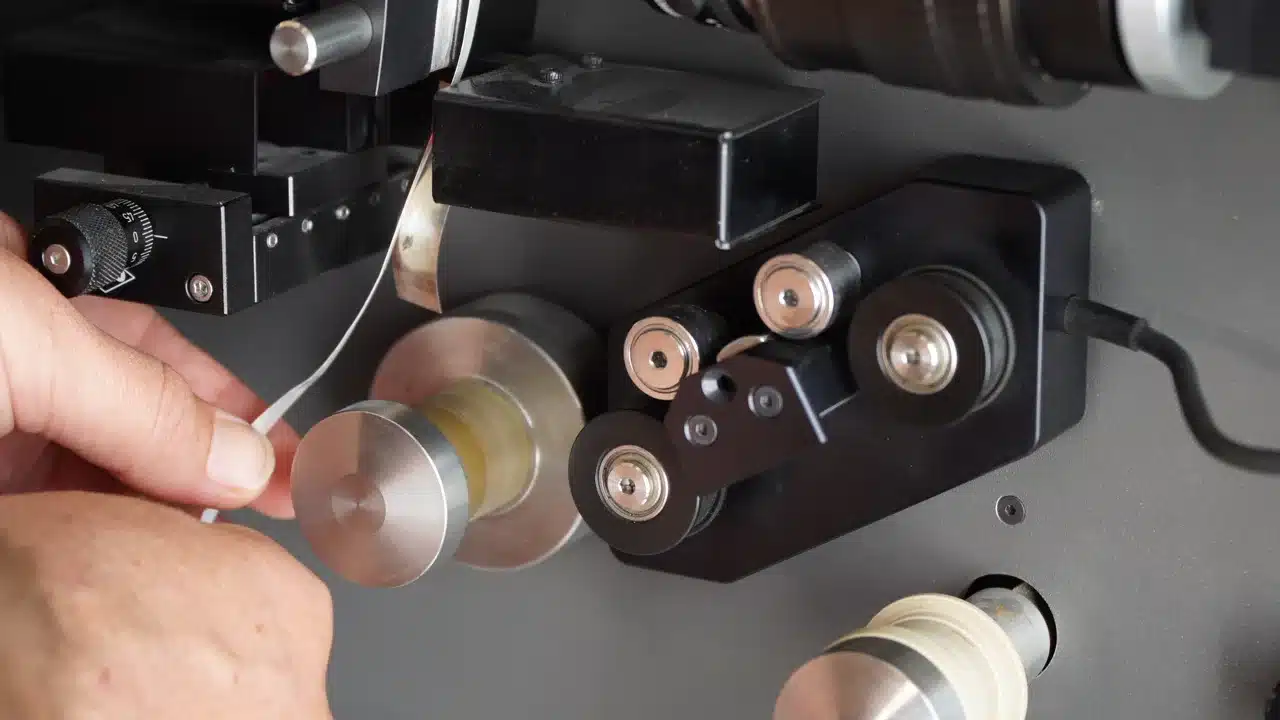
Stages 1 and 2 scan clean. Stage 3 is harder, but on the right machine it is still possible: a scanner with no sprockets and no claw, one that carries the film gently without touching the damaged perforations. In our studio, every reel is scanned as true frame-by-frame on the Muller HDS+, an archival machine that captures each frame individually, which is why shrunken and warped film passes through it safely. After scanning, the footage moves to our dedicated color suite for restoration and color correction, because film with vinegar syndrome almost always arrives with fading too. Pricing is transparent: 30 NIS per real minute for 8mm and Super 8, and 65 NIS per minute for 16mm film. If any term here is unfamiliar, our film glossary explains it all.
Smell vinegar? Don't wait for the next stage.
Send us everything by door-to-door courier, anywhere in Israel. We will scan one full minute free of charge and send it to you, and only then do you decide. You are also welcome to sit with us at the machine and watch one of your reels being scanned, full transparency. Turnaround is about 7 business days for small jobs and about 21 for large ones. Studio HanaBi, Rishon LeZion: 03-5610368 · Contact us
Frequently asked questions
Does a vinegar smell mean the film is already lost?
No. Stages 1 and 2 scan completely clean, and stage 3 can often still be scanned on a sprocketless machine. Only the final stage, where the film crumbles to powder, is truly gone. The smell is a warning, not an obituary.
Can vinegar syndrome be stopped or reversed?
Reversed, no; the chemical damage is permanent. Slowed, dramatically: Image Permanence Institute data shows that moving film from 70°F to 40°F stretches its life from about 40 years to about 350. Cold and dry are the only brakes, and scanning is the permanent fix.
Is it safe to project a reel that smells of vinegar?
No. Decaying film shrinks, and Kodak considers anything over 1% shrinkage unsafe to project: the projector claws tear the perforations and brittle film snaps mid-reel. Sprocketless scanning is the only safe way to watch it.
Can vinegar syndrome spread to other reels?
In practice, yes. Acid vapor from an infected reel builds up in a closed box and accelerates decay in the healthy reels beside it. Isolate any reel that smells, air out the boxes, and never store acetate film in sealed plastic bags.


