
The short answer: Yes — torn, snapped or badly spliced 8mm film can almost always be repaired and scanned. The tear itself is the small, solvable part of the problem: we re-splice it, clean it, and scan it. The damage that is genuinely hard to undo is the damage caused by trying to run a damaged reel through an old home projector one more time.
Most of the reels that reach our lab have already been through exactly that. Someone finds a box in a closet, dusts off grandfather's projector, threads the film, presses start — and the film snaps in the middle of the best scene. It happens because the problem with a fifty-year-old reel is never "one tear". It is a base that has dried and shrunk, old splices that have let go, and sprocket holes worn thin at the edges. A projector applies sharp mechanical stress to precisely those weak points, sixteen to eighteen times per second. A lab does the opposite: it removes the stress, treats each defect separately, and only then moves the film past a sensor. If you are not sure which format you are holding, our guide to 8mm and Super 8 film walks through the differences.
Why is a home projector the single biggest threat to damaged film?
A projector was designed for fresh, flexible film — not for stock that has been drying in a storage room for decades. Its sprocket wheel pulls the film by the perforations, and every pull is a small impact. On healthy film that is invisible; on brittle film with lifting splices, the very first pull is the one that tears. On top of that, the projection lamp concentrates intense heat on a single frame, and if the film hesitates for a moment — and it does hesitate, because an open splice catches in the gate — the image burns through in seconds. A burn is the one kind of damage in this field that is truly irreversible.
The handling and storage guidance published by the Library of Congress and by the National Film Preservation Foundation repeats the same principle: inspect and repair film before it goes through any machine, never after.
What kinds of damage do we actually find on 8mm reels?
Home reels were rarely stored in ideal conditions — a living-room cabinet, an attic, a damp basement. Damage almost always arrives as a combination of several conditions rather than a single fault. Here is what we see in practice and what each case requires:
| Type of damage | What it looks like | Professional treatment |
|---|---|---|
| Clean break across the film | The reel is in two pieces, usually near the head or tail | Align, trim cleanly on a frame line, re-splice and scan normally |
| Old splice that has opened | Yellowed tape or crumbling cement between two segments | Remove adhesive residue and re-splice with a press or ultrasonic splicer |
| Torn perforations | Sprocket holes along the edge are ripped or stretched | Gentle transport that does not rely on a sprocket wheel; local reinforcement if needed |
| Vinegar syndrome | Sharp vinegar smell on opening the can, film curling and shrinking | Isolate from healthy reels, stabilise, scan as a priority — the process cannot be reversed |
| Buckled or wavy film | Fluttering edges, an image that will not hold focus | Controlled relaxing and flattening, scanning with focus-plane adjustment |
| Dust, mould and oil | White specks, black dots, a tacky surface layer | Manual and wet cleaning with film-specific solvents before scanning |
What is vinegar syndrome, and how much time is really left?
Most home 8mm film was manufactured on a cellulose acetate base. Over time that base breaks down chemically and releases acetic acid — the vinegar smell that hits you the moment an old can is opened. The reaction is autocatalytic: the more acid accumulates inside a sealed can, the faster the decay runs, until the film shrinks and curls beyond the point where any machine can transport it.
- At ordinary room conditions (around 21°C and roughly 50% relative humidity) acetate film lasts about 40 years before the syndrome begins. Most home reels are well past that age.
- In cold storage at around 4°C, life expectancy stretches dramatically — into the centuries, according to research by the Image Permanence Institute.
- The process is irreversible. Cold slows it down; nothing reverses it. Digitisation is the only action that preserves the content permanently.
- Separate any vinegary reel from the rest of the box — the acid accelerates decay in healthy neighbours sharing the same container.
What should you do at home — and what must you never do?
The honest answer is: almost nothing. The most useful thing you can do is leave the film alone and pack it properly for collection. Every home repair attempt — clear tape, contact glue, a cut with scissors — creates a problem that takes longer to undo than the original tear, because the foreign material has to be removed before a proper splice can be made.
- Do not project it. Not even "just to see what is on there". That is the action that turns fixable damage into permanent damage.
- Do not splice it yourself with sticky tape, masking tape or glue. Adhesive migrates into the image layer and stains it.
- Do not clean it with water, alcohol or a cloth — lengthwise scratches on the emulsion stay in the scan forever.
- Do keep every fragment, including short pieces that look worthless. They can usually be threaded back into the sequence.
- Do pack in a rigid box, each reel separately, without pressure and without rubber bands that fuse to the film.
- Do flag any reel that smells of vinegar and tell us in advance, so we can move it to the front of the queue.
How is a broken reel repaired and scanned in the lab?
Our process is broken into stages, and every stage exists to take stress off the film before it reaches the scanner:
- Manual inspection: the reel is wound across a bench and examined metre by metre — locating splices, tears, worn perforations and signs of shrinkage.
- Cleaning: dust, oil residue and mould are removed with film-specific solutions, before dirt is baked permanently into the digital scan.
- Re-splicing: every old splice is removed and replaced with a fresh press or ultrasonic splice, producing a thin, strong join that passes the scanner without a bump.
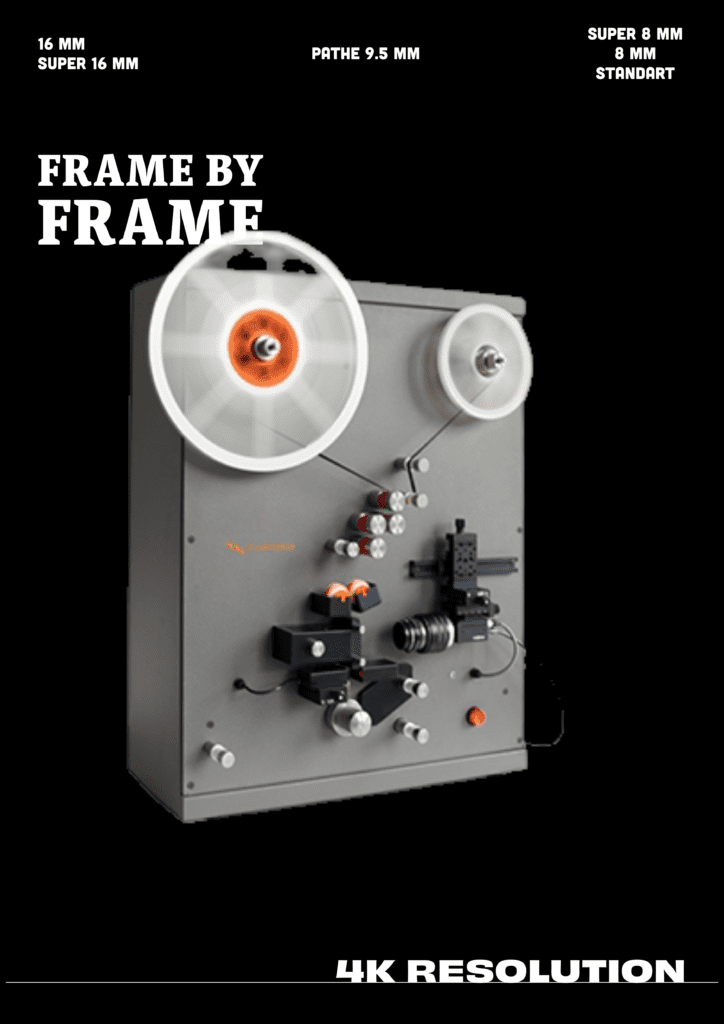
- Frame-by-frame scanning: each frame is captured individually with gentle transport, without the cyclic stress a projector applies.
- Post-processing: image stabilisation, exposure balancing and, where needed, colour restoration and repair for film that has faded to pink or yellow.
Why does a frame-by-frame scanner succeed where a projector fails?
The difference is in how the film moves. A projector moves film in jerks — stop, project a frame, yank the next one in — and every jerk is a sudden load on the perforations and the splices. A professional frame-by-frame scanner moves the film slowly and continuously, finds the frame position optically instead of trusting a sprocket wheel, and photographs each frame separately on a digital sensor. There is no hot projection lamp and no violent pull, so a splice that would have burst in a projector simply passes through. There is a further advantage: if a section is missing or destroyed, you lose only that section — not the reel.
We use the same approach across every home film and video format; the full list lives on our formats and media types page, alongside video tape transfer. Scanning rates and other services are listed together on the price list.
That broken reel still holds your family's faces and voices — it deserves one last chance.
Door-to-door courier service throughout the country, in both directions. Small jobs come back to you in about 7 business days, large ones in about 21. Unsure, or want to ask about one specific reel? Call the studio at 03-5610368 or write to us through our contact page — we are glad to advise, with no obligation whatsoever.
Frequently asked questions
My film snapped completely in two — can it still be scanned?
Yes. A clean break across the film is one of the simplest defects to handle: we align the ends, trim cleanly on a frame line and re-splice with a press or ultrasonic splicer. You normally lose one or two frames at the join, which is less than a fraction of a second on screen. Please send both halves, along with any small fragments that look unimportant.
Why should I not project the film before sending it in?
A home projector pulls film by the sprocket holes in rapid jerks, loading exactly the old splices and worn perforations that are already weakest. The projection lamp also generates intense heat, so if the film hesitates for a moment the image burns. A burn is the one form of damage that cannot be repaired, whereas tears and open splices can almost always be fixed in the lab.
There is a strong vinegar smell in the can — is the film lost?
Not necessarily, but the clock is running. That smell indicates decay of the acetate base, a self-accelerating process that cannot be reversed. At room conditions of around 21°C and about 50% relative humidity, acetate film lasts roughly 40 years before the syndrome starts, while cold storage at around 4°C extends that into many centuries. Until the film shrinks and curls too severely, it can usually still be scanned — which is why such reels should be prioritised.
What is the best thing to do at home with a broken reel before shipping?
Almost nothing, and that is the honest answer. Do not splice with sticky tape or glue, do not clean with water or alcohol, and do not try to project it. Collect every fragment into a rigid box, lay each reel separately without rubber bands or pressure, and label any reel that smells of vinegar. Every home treatment adds foreign material that has to be removed in the lab before a proper splice can be made.


