
The short answer: An old projector is the most dangerous machine your family film will ever meet. A projector pulls film using teeth that engage the perforation holes along its edge, assuming those holes sit exactly where they were manufactured. Old film shrinks, and the holes move. According to Kodak, shrinkage of more than 1% is no longer safe to project. A single screening can turn a fully scannable reel into a torn one. The only safe way to watch it is to scan it.
What does a projector actually do to film?
A projector is not a gentle viewing device. It is a mechanical system that pulls film by force, stops it dozens of times per second in front of a light window, and moves on. All of that pulling rests on a single point: the perforation holes along the film's edge. The drive sprocket's teeth enter those holes, and every bit of the motion depends on the holes being exactly where they are supposed to be.
That is where the problem lies. Home movie film — 8mm and Super 8, 9.5mm or 16mm — is built on a cellulose acetate base, and acetate shrinks with age. As the film shrinks, the distance between the holes contracts, while the distance between the projector's teeth remains exactly what it was in 1965. After a few dozen frames the error accumulates, and the tooth no longer meets a hole. It meets the film itself.
What is the number that decides it — and how do you know it?
Kodak draws a clear line: shrinkage of more than 1% is not safe to project. One percent sounds negligible, and that is precisely the danger — film that has shrunk 1.5% looks exactly like healthy film to the naked eye. You cannot see shrinkage. You can only measure it, or infer it from other signs.
The most accessible sign is smell. Vinegar syndrome is exactly the process that causes shrinkage: the acetate decomposes, releases acetic acid, and the film contracts and stiffens. So any vinegar smell, however faint, is also a projection warning — it tells you shrinkage is already underway. Film that smells of vinegar does not go into a projector. Full stop.
What actually happens when you project shrunken film?
| What happens in the machine | Damage to the film | Reversible? |
|---|---|---|
| The tooth misses the hole and presses its edge | Perforations tear, one after another | Still scannable, but the damage is permanent |
| The film loses grip and chatters in the gate | Lengthwise scratches across the image layer | No. The scratch is in the picture itself |
| Brittle film catches and stretches | A full break mid-reel | Can be spliced and scanned |
| The reel jams and the machine keeps pulling | Folding and creasing across dozens of frames | Usually not |
Look at that third column. Most of this damage is not "the film is lost" — it is "the film will never be what it was." A torn reel still scans after splicing, but the frames that tore away do not come back, and the scratches stay in the image forever. That is the difference between damage you can work around and damage that is burned in.
And what about the lamp?
There is one more factor that is easy to forget: a projector holds the film stationary in front of a strong light source, frame by frame. As long as the film keeps moving, each frame is exposed for a fraction of a second. But if the film jams — and old, brittle film jams — that single frame stays parked in front of the lamp. That is the moment irreversible local damage happens to one frame, and often to precisely the frame someone wanted to see.
So how do you actually watch it?
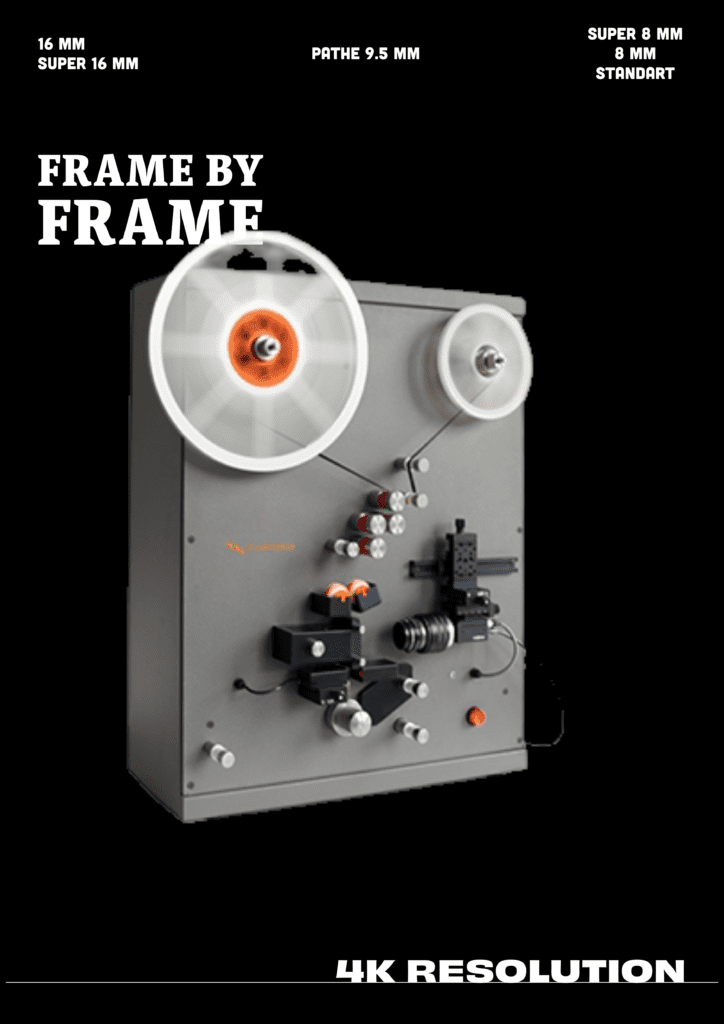
The answer is not to give up on watching — it is to change the machine. Frame-by-frame scanning on a Muller HDS+ archival machine works the exact opposite way from a projector: it does not rely on teeth or perforation holes. The film is guided gently, every frame is photographed individually, and shrunken film or film with damaged perforations passes through safely — exactly the cases a projector would destroy.
After scanning, the material goes through restoration and color correction, because film of this age almost always arrives faded as well. Pricing is transparent: 30 NIS per real minute for 8mm and Super 8, and 65 NIS per minute for 16mm film. And to close one loop: properly stored 8mm film survives for decades — time alone is not the enemy here. The projector is.
Ran into a term you do not know? Our film glossary explains everything.
Before you plug in that projector — stop.
Send us the reels by door-to-door courier, anywhere in Israel. We scan one minute free and send it to you, and only then do you decide. And if you like, you are welcome to sit beside the machine and watch your own reel being scanned in front of you — full transparency. Turnaround: about 7 business days for small jobs, about 21 for large ones. Studio HanaBi, Rishon LeZion: 03-5610368 · Contact us
Frequently asked questions
I projected the film once and nothing happened. Is it fine?
It is quite possible your film has not shrunk enough yet, and that is good news. But a screening that went well is no guarantee for the next one: shrinkage continues over time, and vinegar syndrome accelerates itself. If the film matters to you, the screening that went well is exactly the right moment to get it scanned.
How can I tell if my film has shrunk, without measuring equipment?
The most accessible sign is the vinegar smell — it indicates the same decomposition process that causes shrinkage. Other signs: the film feels stiff rather than flexible, the edges are wavy, or the reel does not lie flat. Any one of these is reason enough not to project it.
My projector is new and well maintained. Does that help?
Not in this case. The problem is not the projector's condition but the mismatch between its fixed tooth spacing and the hole spacing that has changed in the film. A new, precise projector will pull the shrunken film with exactly the same force — and tear it just as efficiently.
Can film that already tore during projection still be scanned?
Yes. Torn film is professionally spliced and then scanned. The frames that tore away and were lost do not come back, but everything else can be fully recovered.


