
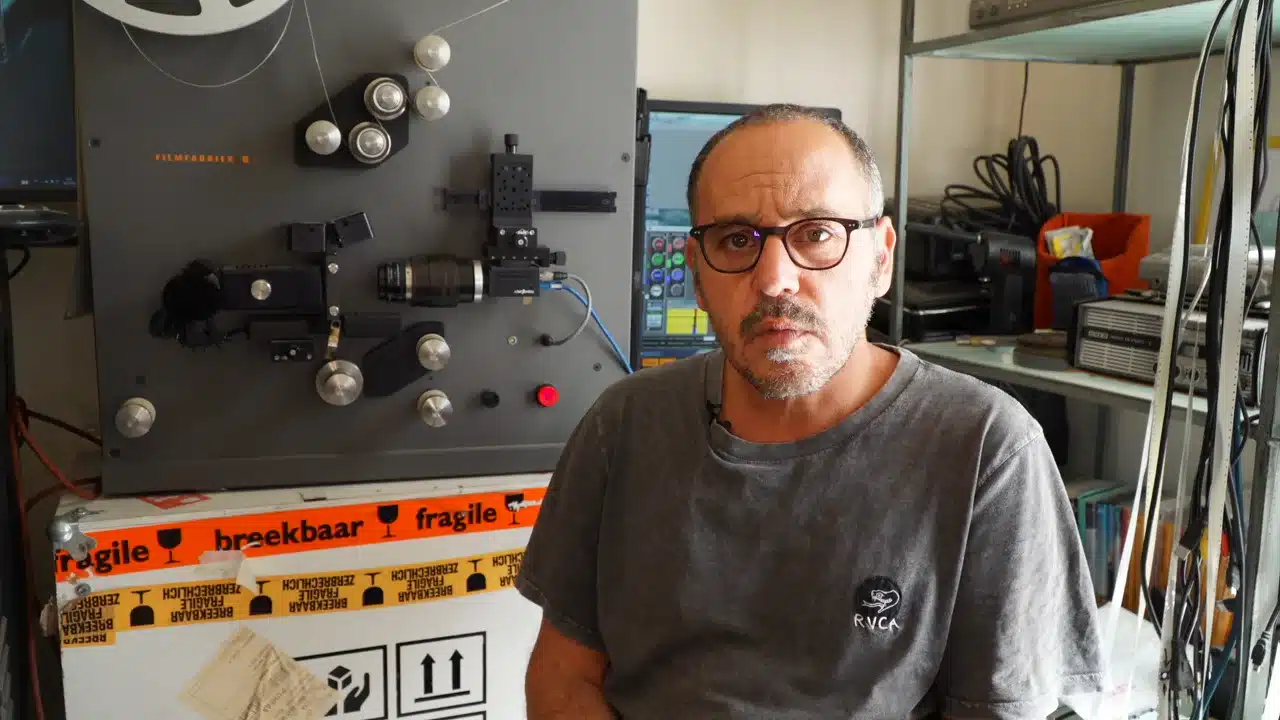
The short answer: The sit-in session is an open invitation to any customer with film reels: come to our studio in Rishon LeZion, sit beside our Filmfabriek Muller HDS+ scanner, and pick one reel from the box. We inspect it by hand in front of you, run it through the machine frame by frame, and you watch the first minute of your film appear on the screen — that minute is on us — before you have decided anything about the other reels. It is not a promotion and not a sales trick; it is simply the most direct way we have found to show what really happens to film in our hands.
Most people who bring us 8mm, Super 8 or 16mm film have never seen a film scanner. They have seen a projector, perhaps a video camera pointed at a wall, and mostly they have heard stories. When these are the only films left of a grandfather, "trust us" is not a good enough answer. So we opened the door.
Why invite a customer to sit beside the machine at all?
Because for us transparency is a working method, not a slogan. Since 2006 more than 5,000,000 frames and photos have passed through our studio, and almost every one arrived from a slightly trembling hand: a box down from the loft, reels nobody has projected in forty years, material with no copy anywhere. The question a customer is really asking is not "how much does it cost" but "what will happen to my film while it is with you". You can answer that in words, or you can simply show it. Our full transparency page (Hebrew) lists the equipment, the steps and the things we do not do; the sit-in session is the same page, in real life.
There is a second reason, less comfortable to say out loud: in this field there is an enormous gap between one "transfer" and another. Film projected onto a wall and filmed with a camera, and film scanned frame by frame on a machine regarded as the standard in the field, give completely different results — and from the outside both are called "8mm transfer". Once you have watched the machine work, the difference stops being a matter of trust and becomes a matter of eyesight.
What happens in the hand inspection, before the film touches the machine?
Every reel that reaches us is inspected by hand before scanning, and in the sit-in session you watch it up close. We take the film out of its box and smell it: a vinegar smell is the sign of vinegar syndrome — the breakdown of the acetate base, which according to IPI and the NFPF accelerates itself and spreads to neighbouring reels in the same box. We pull a few centimetres against the light and check the perforations, the flexibility, and the old splices your parents made at the kitchen table. Old film shrinks, and Kodak's guidance is that shrunken film is no longer safe to project: the projector's sprocket teeth tear the perforations. Our scanner has no teeth at all, which is exactly why we can run a reel a projector would have destroyed.
The inspection takes a few minutes, and at the end we tell you out loud what we found: clean film, film with splices that need reinforcing, film with a smell that should be scanned first and stored apart from the rest. If anything needs treatment, you hear it from us, not from the invoice.
What does frame-by-frame scanning look like?
The Muller HDS+ does not project the film. It guides it gently, without sprockets and without tension, and photographs each frame separately as a complete still image. On the screen beside you the frames are captured one after another, and you also see what a home projector never showed: the full edges of the frame, the grain of the film, the colour as it really sits on the emulsion. The machine knows exactly how many frames it captured, and from that comes the true running time at the original filming rate — so the motion looks natural rather than too fast. The method is explained in full in our frame-by-frame scanning guide.
The first minute of the reel you chose is the minute on us. You watch it come out, look at a grandfather younger than you are today, and only then decide whether to continue, with how many reels, and in which file format — ProRes, MXF or MP4.
| Stage | What we do | What you see |
|---|---|---|
| Opening | Take the reel out, smell it, check perforations and splices | The real condition of the film, in hand |
| Preparation | Remove dust, reinforce a weak splice if needed | Why old film does not go straight into a machine |
| Threading | Guide the film through a sprocketless scanner | The film is neither stretched nor torn |
| Scanning | Capture each frame separately and set the rate | The first minute of your film on screen — on us |
| Wrap-up | Suggest a scanning order for the rest of the box | What to scan first, and why |
What should you bring?
The reels, of course, preferably in their original boxes — the writing on the box ("wedding", "trip to Eilat", "Yossi's bar mitzvah") helps us and you. If there are several reels, choose in advance the one that matters most to you, or the opposite: the one that worries you, the one with the smell or the brittle film. No projector is needed, and we specifically ask you not to project at home "just to check" before coming — the first run after decades is the most dangerous moment for the film, as the Library of Congress and the NFPF warn, and the rule is to inspect and treat before running through a machine, not after. If you are coming on behalf of your parents, bring their questions too.
How do you book a session?
Sessions take place at the studio at 9 HaMa'ayan St., Rishon LeZion, by appointment, because the machine spends most of the day on other customers' films and we want to give you real time rather than a quarter of an hour between reels. Call 03-5610368 or leave your details on our contact page, say you would like a sit-in session, and roughly how many reels you have. After the session, if you decide to go ahead, the rest of the reels can stay with us or come later by courier — there is no need to decide on the spot, and no need to bring the whole box the first time.
Who is the session especially for?
Three groups, mainly. First, anyone with a large archive — dozens of reels from a family, a kibbutz, a school or an institution — who wants to see the process once before entrusting everything. Second, heirs who feel a heavy responsibility, sometimes on behalf of siblings or parents who are no longer here, and want to be certain the film is in the right hands. Third, anyone comparing labs who wants answers to the questions in our seven questions for choosing a conversion service — not over the phone, but in front of the machine. Full details of the service are on our 8mm and Super 8 film transfer page.
Come and sit beside us, and we will scan one reel together — the first minute is on us.
We send couriers to your door anywhere in Israel, in both directions. Small jobs are usually ready within about seven working days, large ones within about 21 working days, and the first minute is on us — you will see how your film comes out before you decide. You can also drop off in person: our studio at 9 HaMa'ayan St., Rishon LeZion, 5 Lisin St. in Tel Aviv, or Mitzpe Hararit in the Galilee. Call 03-5610368 or leave your details on our contact page. What each service includes is listed on our price list (Hebrew).
Frequently asked questions
Does the sit-in session cost anything?
No. The hand inspection and the first minute of the reel you chose are on us. You pay only if you decide to continue, at the regular price list.
Can I bring video tapes to a sit-in session?
The session is for film — 8mm, Super 8, 9.5mm and 16mm — because that is where you watch frames being captured. Tapes are also inspected by hand, but in a different process, which we are happy to explain by phone.
How long does the session take?
Not long: the hand inspection takes a few minutes, then the first minute is scanned in front of you. Allow about an hour so nobody has to rush.
What if the session shows the film is badly damaged?
Then you know it before paying for anything. We explain what can be saved and what cannot, and a reel that cannot be scanned is not charged.


