
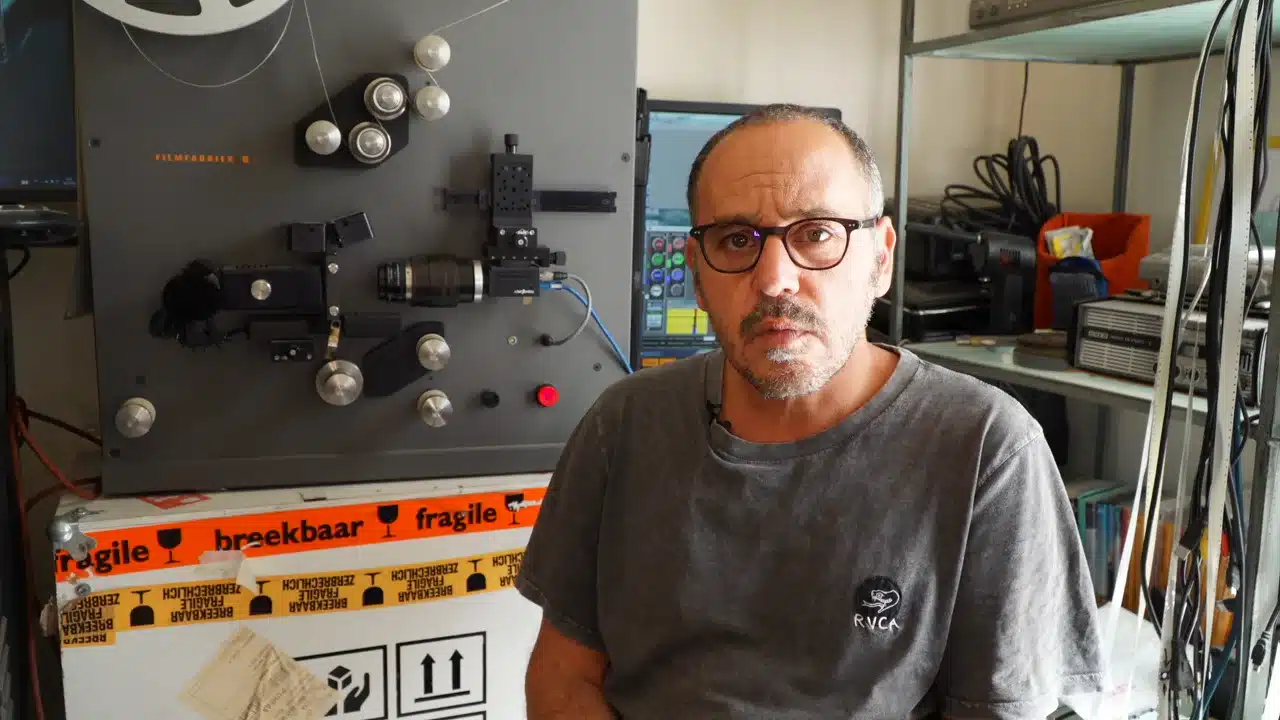
The short answer: Frame-by-frame scanning means the film never runs: each frame is stopped, lit and captured on its own, and the images are assembled into a film afterwards at the right speed. With old film that matters: Kodak says film shrunk by more than one percent is unsafe to project, and typical old home movie film has shrunk 1.25–2 percent. We scan on a Filmfabriek Muller HDS+, a machine costing around 200,000 shekels, after inspecting every reel by hand.
You found your parents' 8mm or Super 8 reels, searched for "film transfer", and everything from a small online gadget to a full lab calls itself "digitising".
What exactly happens to the film in a frame-by-frame scan?
The film advances gently, one frame at a time, with nothing in the perforations and no projection speed. At each stop a sensor photographs the frame as a still; the thousands of stills are then assembled at the rate the original camera shot. Exposure, colour and steadiness can then be corrected per frame. Details are on our frame-by-frame film scanning page.
How is that different from projecting and filming the wall?
The old approach projects the film and points a video camera at the picture; telecine refines it, but the film still runs continuously. Either way it moves at projection speed, 16–18 frames per second for a home projector according to Kodak, while the camera records at its own rate. Hence flicker, jumps, and motion that looks too fast when 16–18 fps film is shown at 24 or 25. And the film travels a projector path, with teeth and tension, exactly what old film cannot take. See why you should never project old film.
Why doesn't an Amazon gadget do this?
Small home devices pull the film through a sprocket wheel and photograph it in motion. No inspection stage, no allowance for shrinkage, nobody to stop when an old splice opens. On old film the perforations are the weakest point, and what tears does not come back. It is viewing equipment, not preservation equipment: not an Amazon gadget. The questions to ask first are in our guide to choosing a transfer service.
| Method | How the film moves | Shrunken film and flicker | Who it suits |
|---|---|---|---|
| Frame-by-frame (Muller HDS+) | One frame at a time, no teeth, after inspection | Safe; no flicker, rate set in the file | Old, brittle or shrunken film |
| Telecine (continuous) | Runs continuously through a transport | Shrunken film can snag | Good-condition film, volume |
| Projector and camera | Projector at full speed | Perforations at risk; flicker | One-off viewing |
| Small consumer device | Sprocket wheel, no inspection | Dragged by force; judder | New film, low expectations |
What about shrunken or brittle film?
A sprocketless scanner does not depend on the exact spacing of the perforations, so it reads film that has shrunk. Library and Archives Canada describe six visible stages of acetate decay: only the last, crumbling to powder, is lost; stages 1–2 scan cleanly and stage 3 is hard but possible without sprockets. Torn film is repaired first; see torn 8mm film.
How do we scan at Studio HanaBi?
Every reel is inspected by hand first: perforations, flexibility, old splices, signs of decay. As the Library of Congress and the NFPF put it, check and treat before running film through a machine; the first run after decades is the most dangerous moment. The film is then scanned on the Muller HDS+ frame by frame, restored and colour-corrected, and delivered as ProRes or MXF for editing and archiving, or MP4 for viewing and sharing. The first minute is on us, and "the shared session" lets you scan one reel with us, as described on our full transparency page (Hebrew). That is how more than 5,000,000 frames and photos have passed through our hands.
Found old reels? Don't project them. Let us scan one minute free and show you the difference.
We send couriers to your door anywhere in Israel, in both directions. Small jobs are usually ready within about seven working days, large ones within about 21, and the first minute is on us — you see how your film comes out before you decide. You can also drop off in person: our studio at 9 HaMa'ayan St., Rishon LeZion, 5 Lisin St. in Tel Aviv, or Mitzpe Hararit in the Galilee. Call 03-5610368 or leave your details on the contact page. What each service includes is listed on the price list (Hebrew).
Frequently asked questions
Does it work for 16mm and 9.5mm film too?
Yes. For 9.5mm, with its single central perforation, it matters even more.
How long does frame-by-frame scanning take?
Longer than projecting and filming. Small jobs usually take about seven working days, large ones about 21.
Can I see a result before I pay?
Yes. The first minute is on us, and a shared session lets you scan one reel with us.
What if the film is torn or the splices have opened?
We repair before scanning, never during it. Only a reel that is ready goes into the machine.


